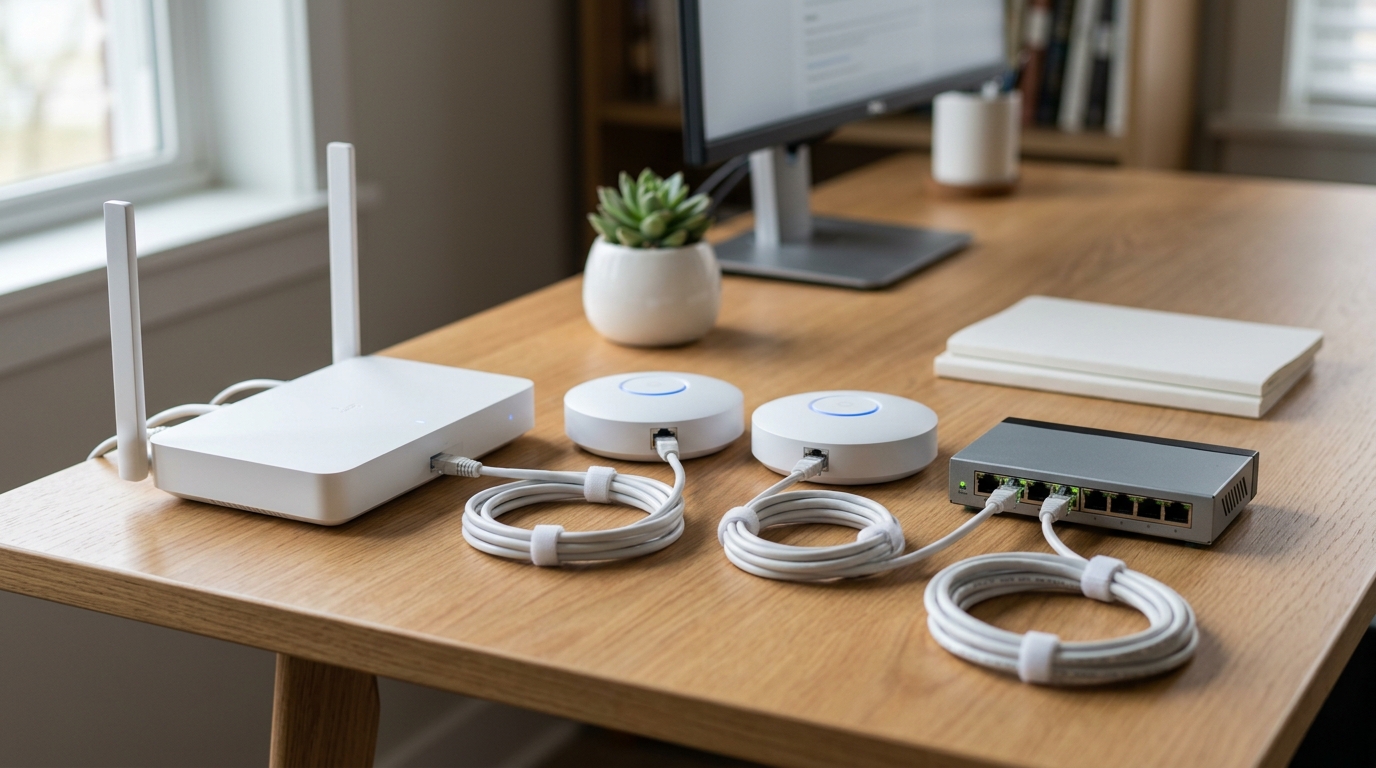

Wholesale networking equipment is the category that rides Latin America’s fiber boom. Every new fiber connection needs a router, and most homes and small offices soon need a mesh system or a switch behind it. The regional router market is growing about 10% a year, faster than anywhere else in the world, and Wi-Fi 7 is now more than half of enterprise access point sales. This guide covers what sells in routers, mesh Wi-Fi and switches, why authorized Linksys supply matters, how import rules shape pricing, and how to build a first networking order from Miami.
Fiber gets installed once. The router behind it gets replaced every three to four years. That is the reseller’s opportunity.
How big is the wholesale networking equipment market in Latin America?
Growing faster than any other region. Mordor Intelligence sizes the global wireless router market at 18.13 billion dollars in 2026, rising to 28.02 billion dollars by 2031 at a 9.08% annual rate. South America is the fastest regional performer at a 10.47% CAGR, driven by fiber-to-the-home expansion and rural connectivity programs. Mesh systems are the fastest-growing product type at 11.74% a year. Wi-Fi 7 is the fastest-growing standard at 24.74%. [Source: Mordor Intelligence 2026]
The driver is fiber. Latin America is projected to reach 117 million FTTH subscribers by 2029, a 52% increase over 2024. Investment topped 5 billion dollars in 2025 alone. More than 110 million households still lack fiber, and operators expect to reach 28 million new homes in the next five years. Local and regional ISPs took more than 60% of net additions. [Source: Fiber Broadband Association 2026]
That last number matters most for a distribution buyer. Small ISPs do not buy customer premises equipment from telecom giants. They buy from regional distributors, in pallets, on terms. That is a wholesale channel that did not exist at this scale five years ago.
Which networking products sell best to resellers in Latin America?
Wi-Fi 6 routers by volume, mesh systems by growth, and unmanaged switches for small offices. Chile already ranks second in the world for fixed broadband speed at 347.4 Mbps average download. [Source: Fiber Broadband Association 2026] A household on a 300 Mbps fiber line quickly finds that the ISP’s free router cannot deliver it to the back bedroom. That is when they buy a mesh system.
| Category | What moves | Why it sells | Brands available through ATC |
|---|---|---|---|
| Wi-Fi 6 routers | Dual-band AX1800 to AX3000 | Replacement for ISP routers; the volume SKU | Linksys |
| Mesh Wi-Fi systems | 2 and 3 node kits, Wi-Fi 6 and 6E | Fastest-growing segment; whole-home coverage on fiber | Linksys |
| Wi-Fi 7 routers | Tri-band BE routers | Premium slot; gamers and prosumers | Linksys |
| Unmanaged switches | 5, 8, 16 and 24 port Gigabit | Small offices, retail, clinics; PoE variants for cameras | Linksys |
| USB adapters and extenders | USB Wi-Fi adapters, Ethernet adapters, range extenders | Attach to laptop and desktop sales; low price, high margin | Linksys |
| Cables and patch cords | Cat6 patch cords, USB-C to Ethernet | Attach to every router and switch sale | Belkin, Linksys |
Wi-Fi 5 is not dead in the region. It still held 41.55% of the router market in 2025. [Source: Mordor Intelligence 2026] So keep one or two entry AC SKUs for price-sensitive buyers. But do not build the assortment around them. Wi-Fi 6 is where the volume is moving, and Wi-Fi 7 is where the margin is.
Why does Wi-Fi 7 matter for a reseller’s networking assortment?
Because the standard has crossed the tipping point. Dell’Oro Group reports that Wi-Fi 7 accounted for more than half of enterprise WLAN sales in the second quarter of 2026. Access point shipments hit a record above 10 million units in the quarter, with buyers accelerating purchases ahead of expected price increases tied to memory component costs. [Source: Dell’Oro Group 2026]
Enterprise adoption leads consumer adoption by a year or two. So Wi-Fi 7 routers are the premium shelf today and the volume shelf in 2027 and 2028. For a reseller, that means two things. First, stock one Wi-Fi 7 router now for gamers, prosumers and small offices. Second, expect to shift the mid-range to Wi-Fi 7 within 18 months. The memory cost pressure that Dell’Oro flags also applies to consumer routers. Buying ahead of price increases is a real consideration this year.
Our gaming peripherals guide covers the gamer segment that buys Wi-Fi 7 first.
Why does authorized Linksys supply matter for wholesale networking equipment?
Because a router is a security device, and firmware is the product. The stakes are rising with the installed base: fiber investment in Latin America passed 5 billion dollars in 2025, and every one of those connections ends in a router someone has to trust. [Source: Fiber Broadband Association 2026] A gray-market router may ship with a regional firmware build that never receives security updates in your market. A counterfeit one may ship with no updates at all. The customer’s home network, their cameras and their banking sit behind that device. When something goes wrong, the reseller who sold it gets the call.
Authorized supply gives a reseller three things:
- Regional firmware and support. Linksys products sold through authorized channels carry the regional SKU, the correct power adapter and access to firmware updates and support in your market.
- Warranty. Authorized units carry the manufacturer warranty. Gray imports from another region are often refused at the service desk.
- Marketplace compliance. Networking is a gated category on Amazon and Mercado Libre. An authorized invoice keeps the listing live.
Our full guide to authorized distributor vs gray market covers how to verify a supplier before the first order.
How do import rules affect networking equipment pricing in 2026?
Networking equipment is radio equipment, so it carries certification requirements on top of duty. In Mexico, since 1 January 2026, goods from countries without a trade agreement face duties of 10% to 50% on 1,463 tariff lines, including electronics. USMCA-qualifying goods from the United States are exempt. [Source: Tetakawi 2026] Routers also need telecom homologation (IFT) and NOM electrical safety labeling for the power adapter. In Colombia, U.S.-origin goods enter at 0% duty under the trade promotion agreement, and Wi-Fi devices need CRC registration.
The practical effect: a router from a U.S. authorized distributor with the right certificates clears customs. The same router routed from Asia without them may not, and pays full duty if it does. Our post on how to import electronics from Miami to Mexico covers the paperwork. Incoterms for electronics importers explains how to quote the shipment.
Networking gear ships well. Routers and mesh kits are light and boxed. Switches are dense. Both travel with laptops, monitors and printers on a mixed pallet from Miami. Buyers serving Central America and the Caribbean route through Panama’s Colón Free Zone.
How should a reseller build a first wholesale networking equipment order?
Start with two Wi-Fi 6 routers, one mesh kit, one Wi-Fi 7 router and a small switch range. Add adapters and cables as attach items. A practical first order for a store, marketplace seller or small ISP:
- 40% Wi-Fi 6 routers. One entry AX1800 and one mid AX3000. These replace ISP routers and are the volume SKU.
- 25% mesh systems. One 2-node and one 3-node Wi-Fi 6 kit. Mesh is the fastest-growing segment and the natural upsell on fiber.
- 15% switches. 5-port and 8-port unmanaged Gigabit, plus one 8-port PoE for camera installs. Small offices, clinics and retail buy these.
- 10% Wi-Fi 7. One tri-band router for the premium shelf and the gaming customer.
- 10% attach. USB Wi-Fi adapters, USB-C to Ethernet adapters, Cat6 patch cords. These attach to every laptop and desktop sale. See our wholesale laptops and computers guide.
Minimums are set by inner carton. See MOQs in wholesale electronics. Payment follows the standard pattern of deposit first, then net terms. See wholesale payment terms explained. Small ISPs buying for installs usually move to net terms fastest, because their reorder cadence is predictable.
One timing note. With South America’s router market growing at 10.47% a year and memory costs rising, this is a category where buying a quarter ahead pays. [Source: Mordor Intelligence 2026] Our Q4 inventory planning guide covers the holiday timing.
How ATC supplies wholesale networking equipment from Miami
Abboud Trading Corporation carries Linksys routers, mesh systems, switches and adapters alongside Belkin cables and the other brands on our brands page. We have supplied retailers, distributors and enterprise buyers across the Americas and the Caribbean for more than 25 years from Miami, with offices in Mexico, Colombia, Panama and Chile.
Networking ships on the same invoice as your laptops, phones, printers and software. So you get one credit line, one shipment and one warranty desk. Retail buyers can start with mixed inner cartons. Distribution partners and ISPs can order by pallet with regional SKUs. Enterprise buyers can ask about switch and access point volumes for office rollouts. To request current networking movers by market or a starter assortment, contact our team.
Frequently asked questions
Should a reseller stock Wi-Fi 6 or Wi-Fi 7 routers in 2026?
Both, in different proportions. Wi-Fi 6 is the volume SKU today. It replaces ISP routers and covers most homes and small offices at a mid-range price. Wi-Fi 7 is the premium shelf. It crossed 50% of enterprise access point sales in the second quarter of 2026, and consumer adoption follows enterprise by a year or two. Stock one Wi-Fi 7 router now for gamers and prosumers. Plan to shift the mid-range to Wi-Fi 7 by 2027 or 2028. Keep one or two Wi-Fi 5 SKUs for price-sensitive buyers, but do not build around them.
Why are mesh Wi-Fi systems growing faster than routers in Latin America?
Because fiber exposes the weakness of a single router. A household on a 300 Mbps fiber line finds that the ISP’s router delivers a fraction of that speed two rooms away. A mesh kit solves it. Mesh is growing at 11.74% a year globally, faster than any other router segment, and Latin America’s fiber base is projected to grow 52% by 2029. Every fiber install is a mesh sale waiting to happen. For a reseller, mesh is also a higher-ticket item with a clear reason to buy, which makes it easy to sell.
What certifications do routers need to import into Mexico or Colombia?
Routers are radio equipment, so they need telecom homologation in addition to electrical safety. In Mexico, that means IFT homologation for the radio and NOM labeling for the power adapter and Spanish documentation. In Colombia, Wi-Fi devices need CRC registration. Regional SKUs from an authorized distributor ship with the required certificates. A router bought gray from another region may not, and customs can hold it. Confirm with a licensed customs broker, because requirements change and vary by tariff code.
Can small ISPs buy networking equipment through a distributor?
Yes, and increasingly they do. Local and regional ISPs took more than 60% of Latin America’s net fiber additions, and they buy customer premises equipment from regional distributors rather than from telecom vendors. A distributor can supply routers, mesh kits and switches by pallet with regional SKUs and firmware, and can extend net terms once an order history exists. ISPs also benefit from consolidating networking with laptops and other electronics for their business customers on one shipment.
Next step
Wholesale networking equipment is the category that grows with every fiber connection. Stock Wi-Fi 6 for volume, mesh for growth and Wi-Fi 7 for margin, and buy authorized. To get a starter assortment for your market, talk to ATC or browse live inventory at shop.abboudtrading.com.
Last updated: September 2026