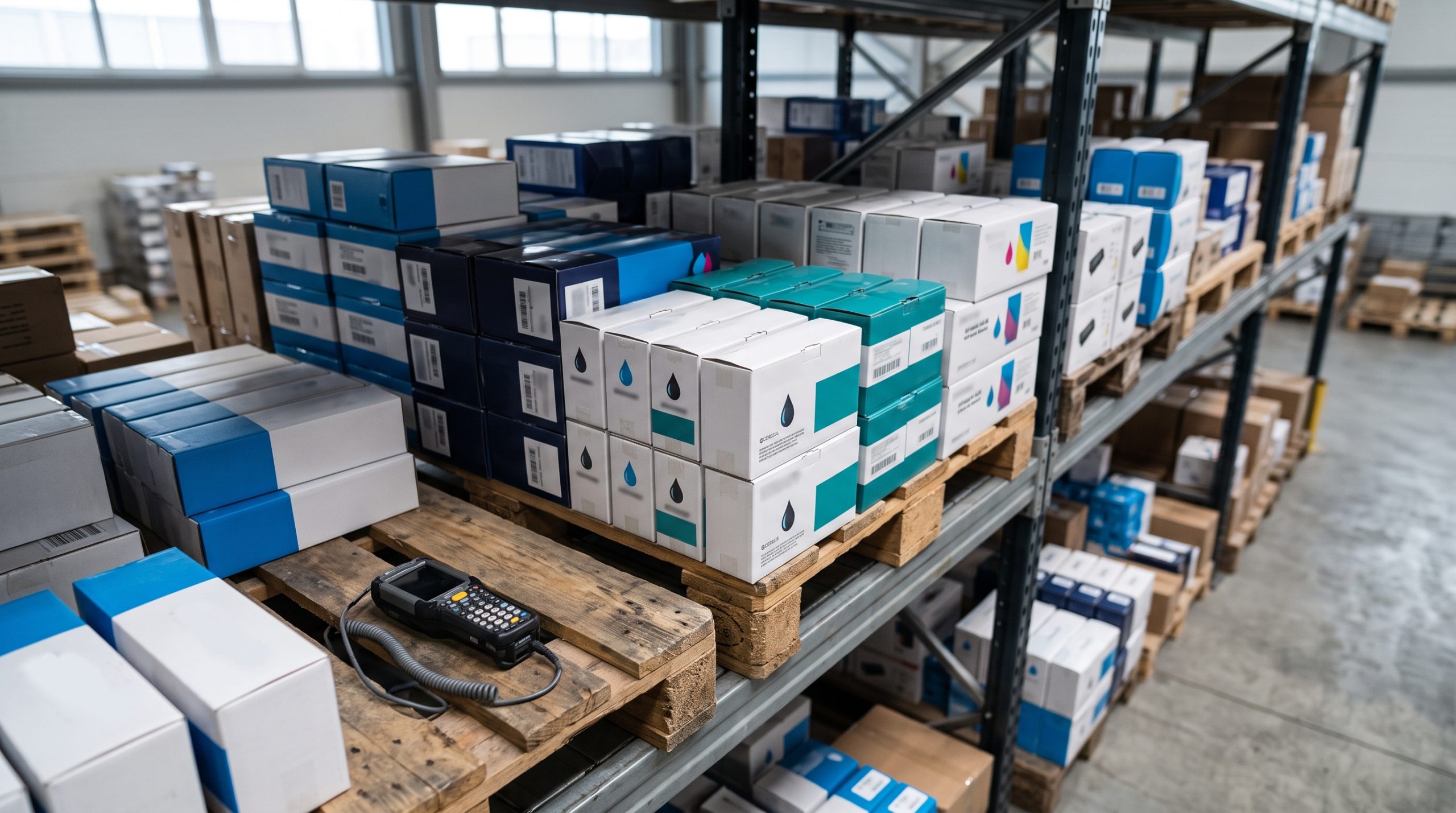

Wholesale ink and toner is one of the most dependable revenue lines a reseller can carry. Every printer sold creates years of consumable demand. When you buy through an authorized distributor, you get manufacturer-backed stock and regional warranty coverage. You also avoid the counterfeit cartridges that flood open marketplaces. This guide explains how HP, Epson, Canon and Lexmark supplies move from factory to shelf. It also covers what sells across Latin America and the Caribbean, and how to size your first order.
Printers are a shrinking hardware category. Cartridges and ink bottles are not. That gap is the whole business case.
Why is wholesale ink and toner still a strong category in 2026?
Because consumables outlive the hardware that uses them. In addition, the installed base of printers in homes, offices and schools is enormous. IDC counted 17.2 million hardcopy peripherals shipped worldwide in the second quarter of 2026. That was down 7% year over year. However, Latin America was one of the few regions that returned to growth in the same quarter. [Source: IDC via IT-Online 2026]
Every one of those units needs ink or toner on a recurring cycle. So do the tens of millions already installed. For example, a small office printing 3,000 pages a month on a mono laser replaces a standard toner every one to two months. A reseller sells the printer once. Then they sell the cartridges twelve times a year. That is an annuity business, not a hardware business.
Three things make the category attractive to retail buyers. First, the SKUs are compact and carry high value per cubic foot. Second, reorder patterns are predictable. Third, the customer comes back on a schedule you can forecast.
Which printer brands and supplies sell best in Latin America?
Three groups cover most of the demand: Epson ink tank inkjets, HP and Lexmark mono laser toner, and Canon office supplies. Epson overtook HP as the number one inkjet brand worldwide in the third quarter of 2025. It reached 34.1% of units, driven largely by its EcoTank refillable line. [Source: Epson citing IDC 2026]
Ink tank matters for Latin American resellers for a practical reason. The per-page cost is a fraction of cartridge inkjets. As a result, price-sensitive households and small shops adopt it fast. The consumable is a bottle of ink rather than a cartridge. That changes your SKU mix and your margin structure.
| Segment | Typical buyer | Consumable | Reorder cycle | Brands available through ATC |
|---|---|---|---|---|
| Ink tank inkjet | Homes, small shops, schools | Ink bottles (4 colors) | 6 to 12 months | Epson, Canon |
| Cartridge inkjet | Homes, home offices | Ink cartridges (XL and standard) | 1 to 3 months | HP, Canon, Epson |
| Mono laser | Offices, clinics, government | Toner cartridge | 1 to 3 months | HP, Lexmark, Canon |
| Color laser | Agencies, print shops, corporate | 4 toner cartridges plus drum | 2 to 4 months | HP, Lexmark, Canon |
Most distributors buying for Mexico, Colombia, Panama and Chile start with a balanced order. In practice, that means HP and Epson ink for the consumer channel, plus HP and Lexmark toner for the office channel. Our Mexico and Colombia teams can share the regional movers by SKU on request.
How does the authorized supply chain for printer consumables work?
It runs from manufacturer to authorized distributor to reseller. Every step uses serialized cartons and regional SKUs. HP, Epson, Canon and Lexmark build cartridges in specific regional configurations. A suffix in the part number identifies the region. For example, the “AL” in HP’s Latin American cartridge codes. An authorized distributor buys those regional SKUs through the manufacturer’s official channel. It then holds them in Miami and in-region inventory. Finally, it sells to qualified resellers with the manufacturer’s warranty intact.
The scale of enforcement shows why the chain matters. In a single year, Imaging Supplies Coalition members ran more than 500 raids. They seized over eight million counterfeit units and components that had entered the market outside authorized channels. [Source: Forbes citing the Imaging Supplies Coalition 2019]
That chain is what a reseller is really paying for. It guarantees three things. The printer’s firmware in your market will recognize the cartridge. The yield on the box is the yield you get. And you can return a defective unit through a documented process. Our post on how distributors handle returns, RMAs and warranty claims explains that last step in detail.
Buying outside the chain removes every one of those guarantees. That applies to marketplace sellers and to brokers with no manufacturer relationship. The savings on paper rarely survive the first firmware update. Nor do they survive the first pallet of duds.
How big is the counterfeit ink and toner problem?
Large enough that manufacturers run their own raid teams. The Imaging Supplies Coalition estimates counterfeit cartridges at roughly 3.5 billion dollars in market value each year. About 85% of the problem is on the toner side. In other words, toner is where the money and the damage concentrate. [Source: Forbes citing the Imaging Supplies Coalition 2019]
Counterfeit toner is a reseller’s worst outcome. It leaks. It damages fusers. It prints at a fraction of the rated yield. Worse, when a customer’s 900 dollar printer fails, the manufacturer denies the warranty claim because a non-genuine consumable was inside. The reseller eats the loss. Usually, they lose the account too.
Practical checks before you buy:
- Ask for the distributor’s authorization letter or partner ID for each brand. You can verify real ones with the manufacturer.
- Match the regional SKU suffix to your market. A cartridge coded for Europe may not work with your local firmware or warranty desk.
- Inspect security labels. HP, Epson and Canon all use tamper-evident holographic or QR labels that you can validate online.
- Compare the unit price to the manufacturer’s published distributor pricing. A quote 30% below every authorized source is a signal, not a deal.
We cover the full verification process in authorized distributor vs gray market.
What margins and order sizes should a reseller expect on wholesale ink and toner?
Consumables usually carry higher percentage margins than the printers themselves. Also, the minimum order is set by carton, not by pallet. Meanwhile, the hardware side is under price pressure. IDC valued worldwide printer shipments at 8.1 billion dollars in the second quarter of 2026, down 5.8% year over year. That is exactly why resellers protect their margin on supplies rather than on the device. [Source: IDC via IT-Online 2026] Manufacturers publish MAP policies on many printer models. Consumables, however, are usually priced more freely. So resellers often sell the hardware near cost and earn on the supplies. Our explainer on MAP pricing for electronics resellers covers how those policies work.
Order sizing depends on your channel:
- Retail store or e-commerce seller: mixed cartons of the ten to fifteen fastest-moving cartridges in your market. Reorder every two to four weeks. See our note on minimum order quantities in wholesale electronics.
- Regional distributor: pallet quantities of top toner SKUs, plus a printer bundle to seed the installed base. Distribution solutions buyers usually negotiate terms after the first two orders.
- Corporate or government supplier: contract volumes tied to a managed print agreement. Here, yield accuracy and warranty support matter more than unit price. This is the enterprise solutions profile.
Payment terms follow the usual wholesale pattern. You prepay or place a deposit on the first orders. Then you move to net terms as history builds. Our guide to wholesale payment terms explains what to expect.
How to source wholesale ink and toner from an authorized distributor in Miami
Start with three things: a partner application, a list of the printer models your customers already own, and a target market. Timing also favors buyers in the region. IDC reported that Latin America returned to year-over-year growth in printer shipments in the second quarter of 2026. The United States and Western Europe declined in the same period. [Source: IDC via IT-Online 2026]
From Miami, an authorized distributor can consolidate HP, Epson, Canon and Lexmark supplies with the rest of your electronics order. As a result, a single shipment carries printers, cartridges, laptops and accessories. You avoid four separate freight bookings. That consolidation is one reason buyers across the region source electronics through Miami distributors.
Shipping consumables is simple. Toner and ink are not dangerous goods for standard freight. Cartons are dense and stackable. The products are not fragile. Our Incoterms guide for electronics importers explains how to quote FOB Miami versus CIF to your port.
Abboud Trading Corporation has distributed consumer and office electronics for more than 25 years. We work from our Miami headquarters, with offices in Mexico, Colombia, Panama’s Zona Libre de Colón and Chile. We are an authorized distributor for HP, Epson, Canon and the other brands on our brands page. We sell printer supplies alongside computing, audio, storage and mobile products to retailers, distributors and enterprise buyers. If you want to add or expand a consumables line, contact our team. Share your target markets and current volumes, and we will build a starter assortment.
Frequently asked questions
Is it legal to resell HP, Epson or Canon cartridges bought from a distributor?
Yes, as long as the product is genuine and came through the manufacturer’s authorized channel. Manufacturers restrict two things. First, using their trademarks in ways that imply you are the brand itself. Second, in some cases, the geography where a regional SKU is covered by warranty. So buy the correct regional SKU for your market. Describe yourself as a reseller of genuine products, not as the brand. Keep your purchase documentation. Authorized distributors can supply the letters and invoices that marketplaces and corporate customers ask for.
What is the difference between OEM, compatible and remanufactured cartridges?
The printer brand makes OEM cartridges, and they carry its warranty. Third parties build compatible cartridges to fit the printer. They cost less and have no manufacturer support. Remanufactured cartridges are used OEM shells that someone cleaned, refilled and resold. Compatible and remanufactured products are legal in most markets. However, they can trigger firmware warnings, lower yields and denied printer warranty claims. Most authorized distributors, including ATC, carry OEM supplies only. That is what corporate, government and warranty-sensitive customers require.
How should a reseller decide which cartridges to stock first?
Start from the printers your customers already own, not from a catalog. Pull the model list from your sales history or your local competitors’ shelves. Then map each model to its cartridge or ink bottle set. Stock the ten to fifteen SKUs that cover the most installed printers. In most Latin American markets, a handful of HP mono laser toners, Epson EcoTank bottles, and HP and Canon inkjet cartridges dominate that list. Ask your distributor for regional movers by SKU. After the first month, reorder based on your own sell-through.
Can a distributor ship printers and cartridges in the same order?
Yes, and consolidating is usually the cheaper option. Printers, cartridges, laptops, accessories and audio products can travel on one commercial invoice and one bill of lading from Miami. That reduces freight and brokerage costs. It also simplifies customs entries. The main planning point is weight and volume balance. Toner cartons are dense and printers are bulky. Therefore, a mixed pallet often ships more efficiently than either product alone.
Next step
Wholesale ink and toner is a recurring-revenue category. It rewards resellers who buy genuine, stock to the installed base, and reorder on a schedule. If you want a starter assortment built for your market, talk to ATC. You can also browse current inventory at shop.abboudtrading.com.
Last updated: September 2026