
Table of Contents
- Why RMA Policy Should Be Part of Your Supplier Evaluation
- Types of Returns in Electronics Wholesale
- How the RMA Process Works Step by Step
- What Your Distributor’s RMA Policy Should Cover
- Managing Warranty Claims with End Customers
- The Grey Market Returns Problem
- How to Minimize Your Returns and Warranty Exposure
- Frequently Asked Questions
1. Why RMA Policy Should Be Part of Your Supplier Evaluation
Most buyers evaluate wholesale electronics suppliers on price, brand availability, and minimum order requirements. Very few ask about returns and RMA policy before placing their first order. This is a significant oversight — because how your distributor handles defective goods directly determines your warranty exposure and your cash flow when problems occur.
A distributor with a clear, enforced RMA process means that when your customer returns a defective unit, you have a path to recover your cost. A distributor without one — or with a policy full of exceptions — means you absorb defective inventory costs entirely. This is one of the criteria covered in our guide on what sets a trusted electronics wholesale company apart in today’s market.
2. Types of Returns in Electronics Wholesale
Dead on Arrival (DOA): Products that fail immediately upon first use or are non-functional out of the box. These should be covered by your distributor under a short DOA window — typically 7 to 30 days from delivery. DOA policies vary by brand and distributor.
Manufacturer warranty claims: Defects that occur within the warranty period (typically 12 months for most consumer electronics). These are covered by the manufacturer’s warranty, which is only valid if the product was sourced through authorized distribution channels.
Buyer error returns: Returns from your customers for reasons other than defects — wrong size, changed mind, incompatibility with their device. These are generally not covered by your distributor’s RMA policy and are your commercial responsibility to manage.
Shipping damage claims: Damage that occurred during transit. These are typically addressed through cargo insurance claims rather than distributor RMA — your freight forwarder’s insurance policy covers this if you have arranged coverage. Read our guide on how to find a reliable electronics freight forwarder for LatAm shipments for more on cargo insurance.
3. How the RMA Process Works Step by Step
Step 1 — Identify and document the defect
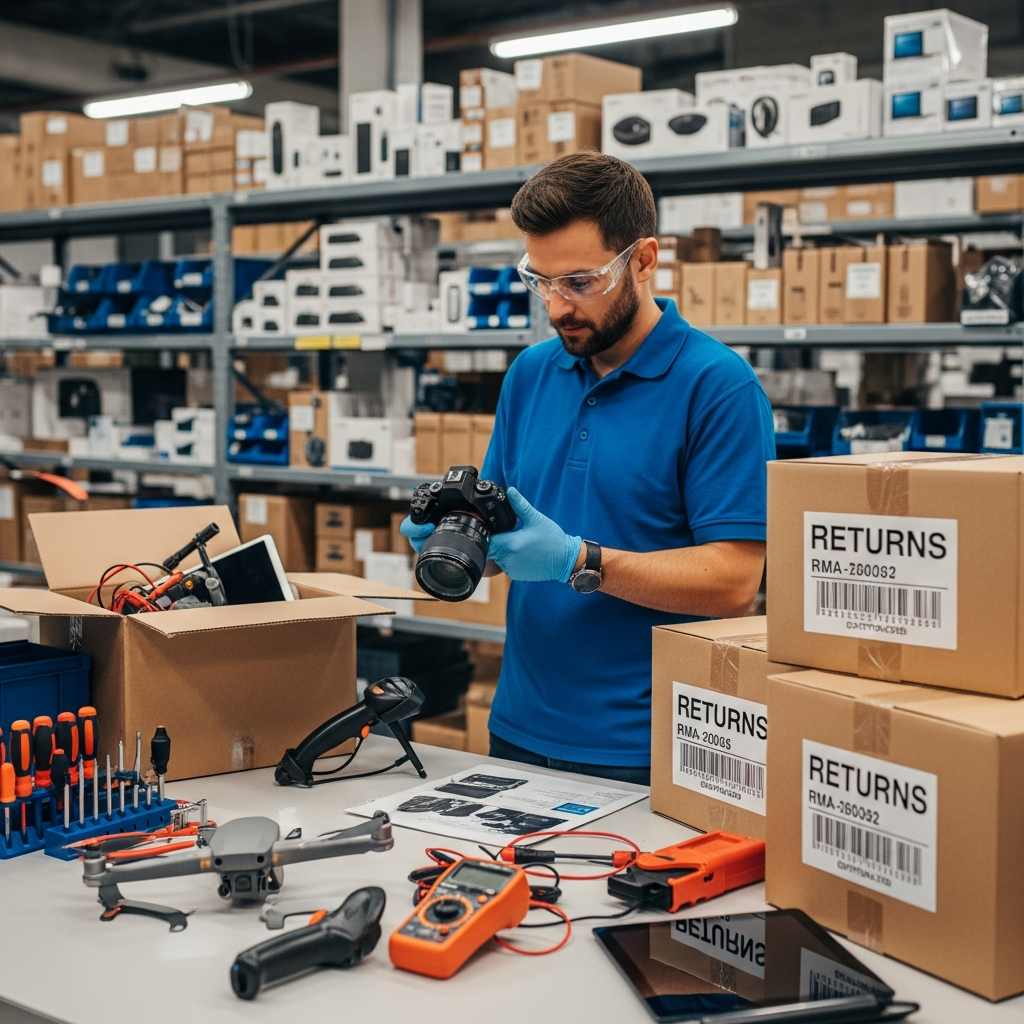
When a customer returns a defective unit, document the defect before accepting the return: photograph the unit, note the serial number, and record what the customer reports. This documentation supports your RMA claim with the distributor.
Step 2 — Contact your distributor’s RMA department
Submit an RMA request to your distributor with the unit serial number, invoice number, purchase date, and documented defect description. Most distributors have an online RMA portal or a dedicated email process for this.
Step 3 — Receive an RMA authorization number
Your distributor issues an RMA authorization number. Do not ship goods back without this — unauthorized returns are routinely rejected.
Step 4 — Ship the defective unit to your distributor
Package the unit carefully and ship it to the address specified by your distributor, with the RMA number clearly marked on the outside of the package. Retain your shipping receipt and tracking number.
Step 5 — Resolution
Depending on your distributor’s policy and the brand’s warranty terms, resolution can take the form of a replacement unit, a credit against future orders, or a refund. Timelines vary — 10 to 30 business days is typical for replacement.
4. What Your Distributor’s RMA Policy Should Cover
DOA window: How long after delivery can you submit a DOA claim? Industry standard is 7–30 days. Any shorter is restrictive; longer is more buyer-friendly.
Defect threshold: Some distributors require a minimum number or percentage of defective units before they process an RMA. Understand this threshold before you have a problem — a policy that requires 5% defects before actioning an RMA claim means small defect quantities are absorbed by you.
Resolution form: Replacement unit, credit, or refund? Most distributors default to replacement. Credits against future orders are common. Cash refunds on individual units are rare.
Who pays return shipping: For international buyers returning from LatAm, return shipping costs can be significant. A quality distributor covers return shipping for genuine DOA and warranty claims.
Turnaround time: How long from RMA submission to resolution? This directly affects your cash flow and your customer service capability.
5. Managing Warranty Claims with End Customers
Your warranty process with end customers needs to be clearly defined before you make your first sale — not constructed on the fly when the first return arrives.
In the LatAm market, consumer expectations around warranty vary by country. Mexico’s consumer protection law (Ley Federal de Protección al Consumidor) provides specific warranty rights. Colombia’s Estatuto del Consumidor provides similar protections. Understanding the legal minimum warranty obligations in your market is your customs broker’s and lawyer’s territory — but knowing they exist is yours.
The practical operational recommendation: match your customer-facing warranty policy to your distributor’s warranty coverage. If your distributor covers 12 months from purchase, you can offer 12 months to your customers. If your distributor covers 30-day DOA only, your customer-facing warranty needs to reflect that reality — or you absorb the gap. Sourcing through authorized channels is foundational here, because it ensures your manufacturer warranty is valid. Read our guide on what it means to work with a B2B electronics wholesaler for how warranty coverage connects to supply chain authorization.
6. The Grey Market Returns Problem
Grey market products — genuine electronics sourced outside authorized distribution channels — create a warranty returns problem that is specific and difficult to resolve.
When a grey market product fails and your customer requests warranty service through the manufacturer’s service network, the manufacturer’s service center identifies the device as outside their authorized distribution chain. Service is denied. The customer returns the product to you. You submit an RMA to your grey market supplier — who may or may not have a formal process, and who has no manufacturer authorization to support a warranty claim on your behalf.
The financial exposure compounds as your sales volume grows. For a complete breakdown of how grey market sourcing creates warranty liability, read our guide on how to source consumer electronics wholesale products with confidence.
7. How to Minimize Your Returns and Warranty Exposure
- Source exclusively through authorized distributors — manufacturer warranty coverage is your first line of defense.
- Inspect incoming shipments on arrival — document damage or discrepancies before accepting delivery from your freight forwarder.
- Track serial numbers at sale — knowing which customer received which unit is essential for managing warranty claims efficiently.
- Set realistic customer warranty expectations — do not promise coverage you cannot deliver.
- Understand the defect rates for your product categories — plan your returns reserve accordingly.
ATC’s RMA process covers DOA and manufacturer warranty claims for products purchased through ATC’s authorized distribution network. Visit our contact page to discuss RMA terms as part of your account setup.
Frequently Asked Questions
What defect rate should I expect for consumer electronics?
Industry averages vary by category. Smartphones typically run 1–3% annual defect rates from authorized sources. Audio products (JBL, headsets) run 2–4%. Wearables run 3–6%. Accessories (cables, chargers) run 1–2% but at much lower individual value. These are planning figures — actual rates vary by brand and product generation.
Can I return products that my customers simply didn’t want?
Generally no — wholesale distributor RMA policies cover defective goods only, not buyer remorse returns. Some distributors allow a limited restocking window for unopened product (typically 15 days), often with a restocking fee of 10–15%. This should be confirmed before you place your order, not after you have excess inventory.
How does ATC handle RMAs for international buyers?
Contact the ATC sales team directly to discuss RMA terms for your account. International buyers have specific logistics considerations for returns (return shipping cost, customs implications) that are best addressed as part of your account agreement rather than on a case-by-case basis after the fact.