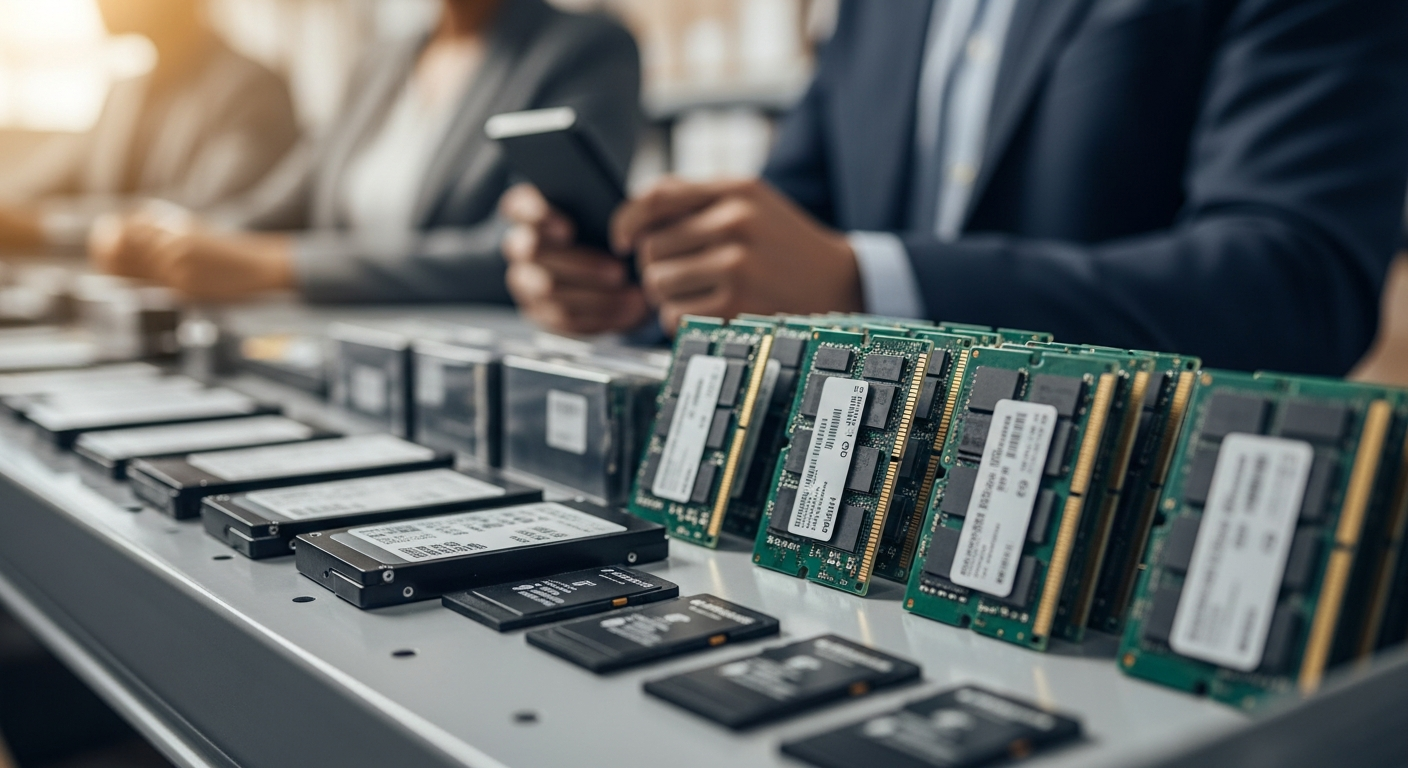

Short answer: Wholesale SSDs and memory refers to bulk purchasing of storage and memory products, including solid-state drives, DRAM modules, flash storage, and memory cards, for resale or enterprise use. It is one of the most reliable categories in tech distribution because storage demand grows with almost every other device and workload. For buyers, the key is knowing which products move, why demand is rising, and how to confirm the stock is genuine.
Storage is the quiet workhorse of the electronics market. It rarely makes headlines, but it sells steadily across consumers, businesses, and data centers. This guide covers what wholesale SSDs and memory include, where demand is heading, and what to check before you buy.
What counts as wholesale SSDs and memory?
Wholesale SSDs and memory covers the full storage stack: solid-state drives, DRAM modules, NAND flash, USB drives, and memory cards, bought in volume for resale or deployment. The underlying market is large and growing: the global NAND flash memory market was valued at roughly USD 71.53 billion in 2025 and is projected to reach USD 161.88 billion by 2035, an 8.51% compound annual growth rate [Source: Expert Market Research 2025]. That breadth is why storage is a staple line for most distributors.
Storage also pairs naturally with other categories, so it fits alongside wholesale laptops and computers and computer accessories in a well-rounded catalog.
It helps to think of the category in tiers. At the consumer end sit portable SSDs, USB flash drives, and microSD cards, high-volume items that resell quickly through retail. In the middle are internal SSDs and DRAM modules bought by system builders and repair channels for upgrades. At the top are enterprise and data-center drives, higher in value and increasingly pulled by AI and cloud buildouts. A distributor who carries across all three tiers can serve a retailer, a system integrator, and an IT reseller from the same catalog, which is part of what makes storage such a resilient line to stock.
Why demand for SSDs and memory is rising
Demand is rising because nearly every technology trend needs more storage, from AI workloads to 5G devices and connected hardware. The data-center segment shows the steepest curve: the data center SSD market was valued at USD 18.5 billion in 2025 and is projected to reach USD 66.3 billion by 2033, a 17.4% compound annual growth rate driven by AI infrastructure [Source: Grand View Research 2025]. Consumer demand tracks the same direction as phones, cameras, and laptops ship with ever-larger capacities.
For resellers, that means storage is rarely a dead-stock risk. It turns over, refreshes on a predictable cycle, and rides the growth of the devices around it.
Capacity trends reinforce the demand. Each device generation tends to ship with more storage than the last, and file sizes keep growing as cameras, apps, and media get richer. A phone that shipped with 64GB a few years ago now commonly starts at 128GB or 256GB, and the same creep applies to laptops and cameras. That steady upward pressure means the same customer base needs more storage over time, not less, which keeps replacement and upgrade demand flowing through the channel even in quieter years for new-device sales.
SSDs, DRAM, and flash: what buyers stock
Different storage products serve different buyers, and a smart catalog carries a mix. Regional demand supports the range: the Latin America consumer electronics market reached USD 78.44 billion in 2024 and is projected to hit USD 145.43 billion by 2033, pulling storage along with devices [Source: IMARC Group 2025].
| Product | Typical buyer | Why it moves |
|---|---|---|
| Consumer SSDs | Retailers, system builders | Upgrades and new-build demand |
| Enterprise / data-center SSDs | IT resellers, integrators | AI and cloud capacity growth |
| DRAM modules | Builders, repair channels | Upgrades and replacements |
| Memory cards / flash | Retailers, camera and mobile | High-volume, recurring purchases |
Brands like Kingston and SanDisk anchor this category, which is why they feature in our overview of Samsung, JBL, and Kingston wholesale for resellers.
Carrying a spread across these products also smooths out demand. Consumer memory cards and flash drives move in high volume year-round, DRAM and consumer SSDs spike around upgrade and back-to-school cycles, and enterprise drives follow business procurement calendars. Because these rhythms do not all peak at once, a distributor stocking the full range sees steadier turnover than one betting on a single segment. For a reseller, that balance is a practical hedge: when one storage line cools, another is usually warming up.
What to check when sourcing wholesale storage
Storage is one of the most counterfeited electronics categories, so verification matters more here than almost anywhere. Global trade in fake goods reached an estimated USD 467 billion in 2021, with electronics among the top categories, and counterfeit flash and SSDs, often relabeled with false capacities, are a persistent problem [Source: OECD 2025]. Before you buy, confirm the supplier is authorized, check serial ranges and packaging, and be skeptical of prices far below market.
The safest path is to buy from an authorized distributor whose storage products come with genuine capacity, valid warranty, and clean documentation, as covered in ATC’s authorized brand lineup.
How to spot counterfeit storage
Counterfeit SSDs and memory cards are convincing, but a few checks catch most of them before they reach your customers:
- Verify capacity, do not trust the label. Fake flash is often firmware-hacked to report a larger size than it physically holds. Test a sample by writing and reading full capacity.
- Inspect packaging and serials. Genuine product has consistent print quality, holograms where applicable, and serials that validate with the brand.
- Distrust steep discounts. A price far below market on a known brand is the clearest warning sign.
- Confirm the channel. Ask whether the supplier is authorized for that brand, then verify it.
The stakes are real. A retailer who unknowingly sells relabeled 1TB drives that actually hold 128GB will face returns, chargebacks, and reputation damage that dwarf any savings on the purchase. Storage is a category where the cheapest offer is frequently the most expensive mistake, which is exactly why authorized sourcing matters most here.
How Abboud Trading Corporation supports storage buyers
Abboud Trading Corporation is an authorized distributor of leading storage and memory brands, including Kingston and SanDisk, serving retailers, resellers, distributors, and enterprise buyers across the Americas and the Caribbean for more than 25 years. Every unit ships genuine, warranty-backed, and fully documented, with regional logistics that keep fast-moving storage in stock. Explore retail and distribution solutions, learn more about ATC, or contact the team.
Frequently asked questions
What is the difference between an SSD and memory?
An SSD is long-term storage that keeps data when powered off, while memory usually refers to DRAM, the fast, temporary working memory a device uses while running. Both are “memory” loosely, but in wholesale they are distinct product lines with different buyers.
Why is the SSD and memory market growing so fast?
Growth is driven by AI infrastructure, cloud data centers, 5G devices, and rising storage capacities in consumer electronics. The data-center SSD segment alone is projected to grow at about 17.4% annually through 2033, and consumer demand follows the same trend.
How do I avoid counterfeit SSDs and memory?
Buy from an authorized distributor, verify serial numbers and packaging, and be cautious of prices well below market. Counterfeit flash is often relabeled with false capacities, so genuine sourcing and documentation are the best protection.
Which storage products sell best at wholesale?
Consumer SSDs, DRAM modules, and memory cards are reliable, high-turnover lines, while enterprise SSDs are growing fastest on data-center demand. A balanced catalog usually carries a mix across consumer and business buyers.
Conclusion
Wholesale SSDs and memory is one of the steadiest, fastest-growing categories in tech distribution, but only if the product is genuine. Stock the right mix, ride the storage demand curve, and source through an authorized channel to protect capacity, warranty, and reputation. To source authorized storage for the Americas and the Caribbean, talk to ATC about becoming a partner.