
Table of Contents
- Why the Caribbean Is a Distinct Market for Electronics Wholesale
- Market Characteristics: What Makes the Caribbean Different
- Key Caribbean Markets and Their Import Structures
- Logistics: Miami to the Islands
- Regulatory Considerations by Territory
- Which Product Categories Move in Caribbean Electronics Retail
- How ATC Supports Caribbean Buyers
- Frequently Asked Questions
1. Why the Caribbean Is a Distinct Market for Electronics Wholesale
The Caribbean is often grouped with Latin America in regional business discussions, but for electronics distribution purposes it operates quite differently. The Caribbean is a collection of individual island markets — each with its own import regulations, customs authorities, currency, and retail infrastructure — rather than a single addressable region.
What ties these markets together, from a wholesale perspective, is Miami. The Caribbean’s geographic proximity to South Florida makes Miami the dominant electronics sourcing hub for the region. Port Miami and Miami International Airport both have established sea and air freight connections to every major Caribbean island, with transit times that are among the fastest for any emerging market in the world.
ATC has served Caribbean buyers for decades — it is as much a Caribbean distribution operation as it is a Latin American one. For context on why Miami sits at the center of the regional wholesale electronics supply chain, read our overview of why electronics wholesale in Miami is a strategic advantage for global buyers.
2. Market Characteristics: What Makes the Caribbean Different
Small market sizes: Individual Caribbean islands have populations ranging from tens of thousands (St. Kitts: ~55,000) to a few million (Dominican Republic: ~11 million). Electronics buyers need to adjust order quantities accordingly — minimum order requirements suitable for Colombian distributors may be too large for smaller island markets.
USD or USD-pegged currencies: Many Caribbean territories use USD directly (Puerto Rico, US Virgin Islands) or maintain USD-pegged currencies (Eastern Caribbean Dollar, Barbadian Dollar). This eliminates exchange rate risk for Miami-sourced goods, similar to Panama.
Tourism-driven demand: Electronics demand in Caribbean markets is partly driven by the tourism sector — hotels, resorts, and retail catering to tourists. This creates demand for audio products (portable speakers), accessories, and chargers that tracks tourism seasonality.
Fragmented retail landscape: Most Caribbean islands have relatively small retail networks — a mix of independent electronics shops, duty-free retail at airports and cruise terminals, and mall-based electronics retailers. The B2B wholesale buyer in the Caribbean is often a small-to-medium retailer buying modest quantities with high frequency.
3. Key Caribbean Markets and Their Import Structures
Dominican Republic: The largest Caribbean economy. The DGII (Dirección General de Impuestos Internos) administers tax on imports; the DGA (Dirección General de Aduanas) handles customs. The Dominican Republic has a free trade agreement with Central America and the US (DR-CAFTA), which may provide tariff benefits on eligible US-origin goods.
Puerto Rico: A US territory. Goods shipped from Miami to Puerto Rico are domestic US commerce — no customs clearance, no import duties. Standard US sales tax applies. This makes Puerto Rico the simplest Caribbean market for Miami-based distributors.
Jamaica: Import duties and GCT (General Consumption Tax, Jamaica’s VAT equivalent) apply on electronics imports. The Jamaica Customs Agency processes commercial imports.
Trinidad and Tobago: As a CARICOM member, Trinidad and Tobago operates under the CARICOM Common External Tariff for goods originating outside the Caribbean Community. US-origin electronics are subject to CET rates, which vary by product category.
CARICOM members generally: The Caribbean Community has a common external tariff structure that applies to goods from outside the bloc, including most electronics from the US. Duty rates and VAT equivalents vary by member state. Your customs broker in each market confirms the specific applicable rate.
4. Logistics: Miami to the Islands
Air freight: The dominant mode for high-value electronics to Caribbean islands. Transit times from Miami are typically 1–3 days. Air cargo connections exist to all major Caribbean airports. For smaller islands, goods may need to connect through a regional hub (San Juan for eastern Caribbean, Port of Spain for southern Caribbean).
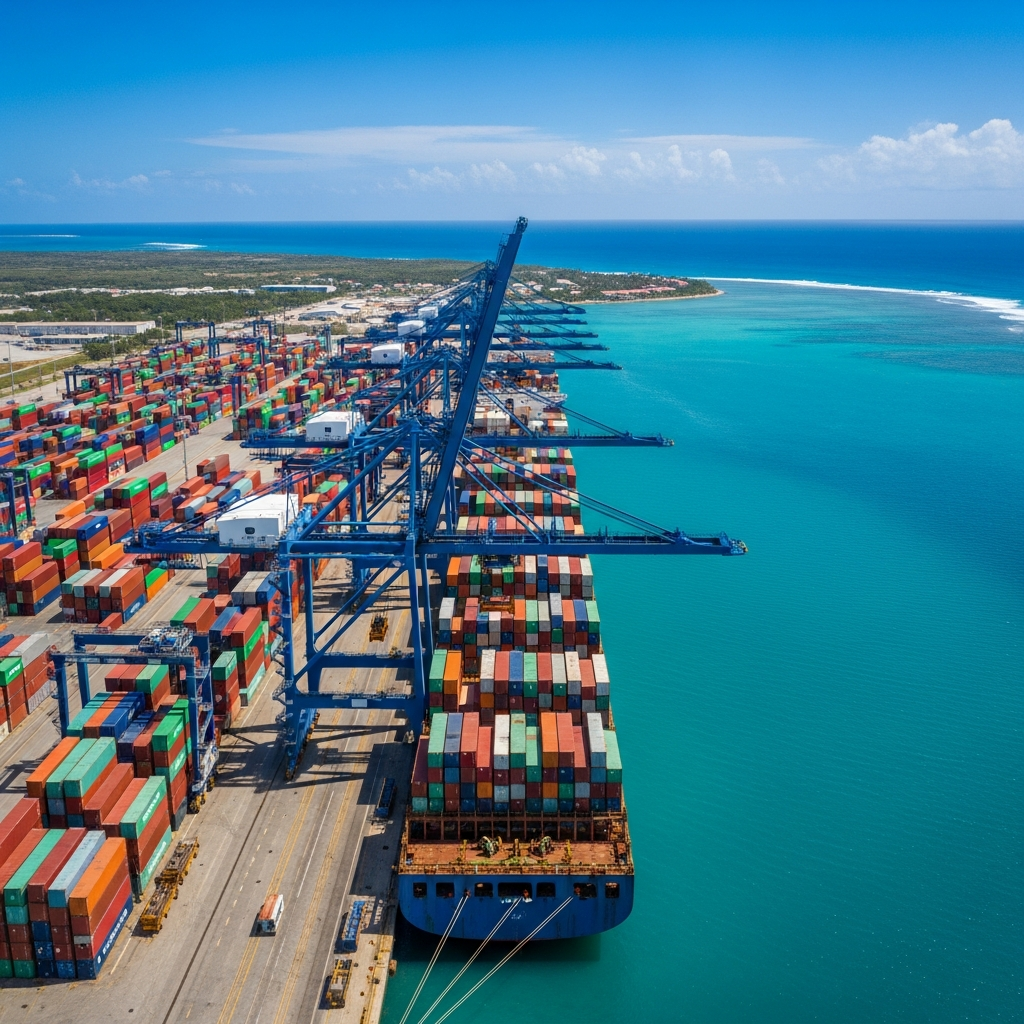
Sea freight: Practical for larger orders. Container services from Port Miami reach major Caribbean ports (Kingston, Santo Domingo, Bridgetown, Port of Spain) in 2–5 days. For smaller islands, ro-ro (roll-on/roll-off) and breakbulk services are available through regional carriers.
Inter-island logistics: Buyers who serve multiple Caribbean islands may consolidate shipments in a hub island and redistribute by inter-island ferry or small aircraft. This requires a logistics partner with Caribbean network expertise — different from a standard Miami forwarder. Read our guide on how to find a reliable electronics freight forwarder for LatAm shipments for what to look for.
5. Regulatory Considerations by Territory
Electronics regulatory requirements in the Caribbean are less standardized than in the larger LatAm markets, reflecting the diversity of political structures (independent nations, UK territories, US territories, French departments, Dutch territories).
- US territories (Puerto Rico, USVI): US FCC standards apply. US-market electronics require no additional certification.
- UK territories (Cayman Islands, BVI, Bermuda): UK/CE marking may be relevant for products sold commercially. Post-Brexit, UK UKCA marking is technically required for some categories.
- Independent CARICOM nations: Each has its own standards body. CROSQ (Caribbean Regional Organisation for Standards and Quality) is working toward regional harmonization but individual country requirements still apply.
Your customs broker in each specific market is the authoritative source on local certification requirements. Do not assume requirements are the same across Caribbean territories — the regulatory diversity is significant.
6. Which Product Categories Move in Caribbean Electronics Retail
Smartphones: Samsung Galaxy mid-range and Xiaomi have strong Caribbean market presence. Prepaid smartphone demand is high — many Caribbean consumers purchase handsets for specific carrier compatibility.
Audio (JBL portable speakers): One of the strongest categories in Caribbean retail, driven by the region’s outdoor and social culture. JBL portable Bluetooth speakers are among the most visible electronics products in Caribbean retail environments. Read about ATC’s authorized JBL distribution partnership.
Accessories: High-volume category driven by phone cases, chargers, and cables. Cruise terminal and airport duty-free retail is a significant accessories buyer in Caribbean markets.
Laptop computers and tablets: Growing category driven by remote work and educational demand following the pandemic-driven digital adoption acceleration. Read our guide on wholesale laptops and computers.
7. How ATC Supports Caribbean Buyers
ATC’s Caribbean buyer network is one of the most established aspects of its regional distribution operation. The company has been shipping to Caribbean markets from Miami for decades and understands the specific logistics, documentation, and product requirements of the region.
For Caribbean buyers, ATC provides: commercial invoices and export documentation prepared for the specific requirements of each territory, coordination with freight forwarders experienced on Miami–Caribbean routes, flexible order quantities suited to smaller Caribbean market sizes, and a full product catalog across mobile, audio, accessories, gaming, and wearables.
Ready to get started? Visit our contact page, browse our full brand catalog, or explore our distribution solutions. You can also reach the sales team directly at (786) 235-7007.
Frequently Asked Questions
Can I send goods from Miami to Puerto Rico without customs clearance?
Yes. Puerto Rico is a US territory. Goods shipped from the continental US to Puerto Rico are interstate commerce, not international imports. No customs declaration, no duties. Puerto Rico operates under US federal law including FCC regulations. This makes it the operationally simplest Caribbean market for Miami-based buyers.
Is the Dominican Republic part of CARICOM?
No. The Dominican Republic is not a full CARICOM member (it has observer status). Its import regulations operate independently of the CARICOM Common External Tariff. Dominican Republic buyers deal with the DGA and DGII under their own national import framework.
How do minimum order quantities work for very small Caribbean island markets?
ATC works with buyers at various scales and understands that Caribbean island markets have different volume requirements than continental LatAm countries. Contact the ATC sales team directly to discuss order size and frequency that works for your specific island market.